


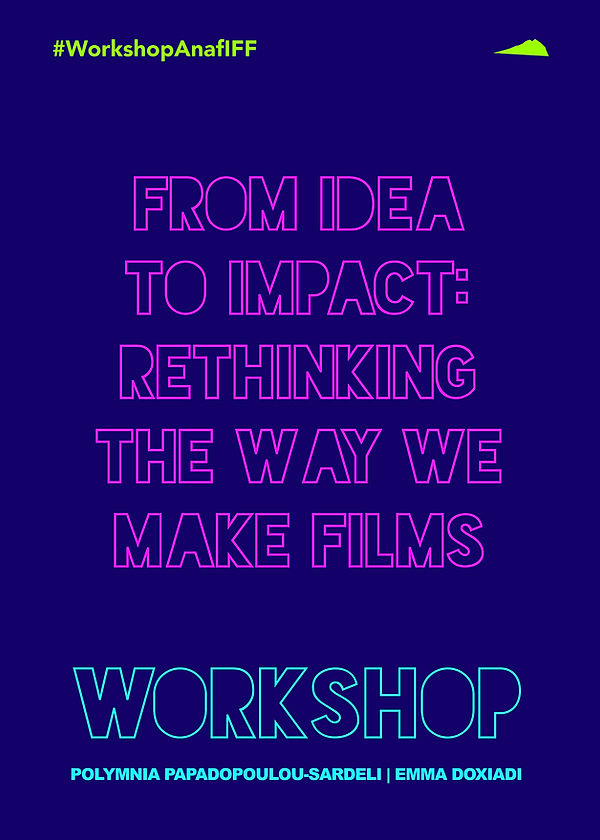
From Idea to Impact: Rethinking the Way We Make Films
Every film leaves a footprint.
This workshop examines how an idea becomes a production, and how, at every stage of the filmmaking process from writing and development to the set and post-production decisions are made that simultaneously affect the creative outcome, the cost, and the footprint of a film.
Through examples from real productions, the workshop approaches filmmaking as an interconnected system:
locations, transportation, energy, time, materials, crews, and organizational structures are treated not as separate elements, but as interdependent parts of the same process.
Sustainability is not presented as a checklist or a limitation, but as a tool for thinking, planning, and collaboration.
The aim of the workshop is to create a common language between creative and production departments and to offer a more conscious understanding of how films are made today.
It is addressed to directors, screenwriters, producers, production managers, technicians, location managers, art & costume departments, and more broadly to everyone involved in the creation of audiovisual works.
Participant Requirements
The workshop is intended for people already working, training, or actively involved in the film and audiovisual industry, with a basic understanding of film production structures and production roles.
Participants are expected to already be familiar with core filmmaking terminology and departments (production workflow, set operations, art department, costume department, location management, etc.), as the workshop is not designed as an introduction to filmmaking, but as a broader approach to how productions are organized and executed.
Previous knowledge of sustainability is not required.
Polymnia Papadopoulou-Sardeli
Polymnia Papadopoulou-Sardeli is a Greece-based producer and founder of Kalibu Productions,, with extensive experience in line producing and production management for both international and domestic film and television productions. Having collaborated with international networks and brands across a wide range of projects, she combines a strong operational background in production with a deep understanding of the creative process.
She has been trained in sustainability programs such as albert (Bafta) and other European initiatives, focusing on integrating sustainable practices into the Greek audiovisual industry. Her work explores practical tools and strategies that connect production efficiency with environmental responsibility.
Emma Doxiadi (participating via Zoom call)
Emma Doxiadi is a Greek-Australian creator and sustainability strategist, and the founder of Everybodies, the first climate-driven production company in Greece. She has led the transition toward sustainable practices across eight festivals, including the Thessaloniki International Film Festival, Evia Film Project, and the Production Designers Gathering, while also providing sustainability services for film productions.
She has spoken internationally on green filmmaking at forums such as the Marché du Film and Creative Europe, actively contributing to the development of a more sustainable model for the film industry.
Register for the workshop here.
Capturing the Present
This workshop explores the unstable nature of the present through 3D scanning and 3D Gaussian splatting as tools for experimental image-making and 3D preservation. Participants will capture everyday spaces, gestures, and environments, transforming them into immersive and fragmented 3D scenes that reflect on memory, presence, disappearance, and change.
Using accessible tools such as smartphone cameras, and beginner-friendly software, the workshop introduces the basics of 3D scanning workflows, with a focus on 3D Gaussian Splatting. No prior technical experience is required, and the focus is placed on learning the basics and experimentation, rather than technical perfection.
Participants will explore how these emerging technologies can be used not only to document reality, but also to reveal instability, distortion, glitches, and traces of what is already slipping away. Together with the facilitator, participants will transform these scans into immersive 3D environments, experimenting with new visual forms and develop new ways of image-making from the resulting material.
Participant Requirements
The workshop is intended for participants interested or already active in digital media, audiovisual practices, visual arts, or creative technologies. No previous knowledge of photogrammetry, 3D scanning, or digital preservation is required.
Participants are expected to have basic familiarity with smartphones, digital media tools, and file handling, as the workshop is designed as a practical introduction to 3D capture and preservation workflows.
Participants should:
-
Have access to a working email or Google account for signing up to platforms and applications.
-
Install the Scaniverse application on their smartphone prior to the workshop.
-
Bring a smartphone or digital camera for capturing material during the sessions.
If possible, though not required, participants are encouraged to bring:
-
A laptop with an Nvidia RTX graphics card (2000 series or newer) with Jawset Postshot installed.
-
A USB drive, external storage device, or phone cable for file transfers.
-
A personal object they would like to preserve or experiment with in 3D during the workshop.
Durim Klaiqi
Durim Klaiqi is a experimental film author and graphic designer from Prishtina, Kosovo. His debut short film, reMemBer2.human, an experimental sci-fi film with a €0 budget, was screened at major festivals such as Vienna Shorts, DokuFest, Tirana IFF, among others, winning acclaim and awards. He then created the experimental documentary “The Goddess on the Throne”, which also premiered at DokuFest and TIFF. In the same year, he finished the experimental documentary PART OF THE SYSTEM, which had its world premiere at Beast IFF. He is currently researching and developing other film projects.
In addition to filmmaking, he has participated in and given guest lectures in workshops and masterclasses, where new technologies such as 3D reconstruction and machine learning are central themes, further expanding his exploration into experimental narratives, memory, technology and hybrid visual forms.
Register for the workshop here.

Reconstructing Memory with Artificial Intelligence Tools
This workshop explores the possibilities and limitations of artificial intelligence in the creation of contemporary hybrid documentaries and in the processing of family archival materials. Taking as a starting point the film Who Was Here? participants are introduced to practical applications of AI tools across all stages of production, from research and scripting to image generation, voice-over creation, and post-production workflows. The session also opens up a critical discussion on memory, historical truth, and the ethical implications of using algorithmic systems in artistic practice.
Participant Requirements
Participants may bring a laptop or smartphone (optionally with Photoshop installed). They are also encouraged to bring a personal or family archive item that holds particular meaning for them — such as a photograph, letter, or similar material, either in physical or digital form. No previous experience is required. The workshop requires a stable internet connection (or reliable mobile data access) and a projector compatible with Mac laptops.
Evi Stamou
Evi Stamou is an award-winning producer, filmmaker, researcher, and PhD candidate in Visual Culture at the Department of Cultural Technology and Communication of the University of the Aegean, based in Athens. She studied Political Economy at Athens University of Economics and Business, filmmaking at Hellenic Cinema and Television School Stavrakos, and holds an MA in Documentary Production, from the University of the Aegean.
For over twelve years, her artistic practice has explored the relationship between traditional cinematic forms and contemporary art, focusing on emerging video technologies and new media. Films she has directed and produced have been presented internationally at film festivals and exhibitions including Doclisboa International Film Festival, Visions du Réel International Film Festival, DOC NYC, Fipadoc International Documentary Festival, Cinemed - Montpellier International Mediterranean Film Festival and Thessaloniki International Documentary Festival.
Her film Who Was Here? (2025, 25’), a documentary exploring the relationship between memory, archival filmmaking, and artificial intelligence, has received international awards, earned a nomination for Hellenic Film Academy Awards, and is distributed globally through
DAFilms.com.
She is currently selected at EMERGING PRODUCERS 2026 program by Jihlava IDFF, recognizing leading emerging documentary producers from Europe and beyond.
Register for the workshop here.
